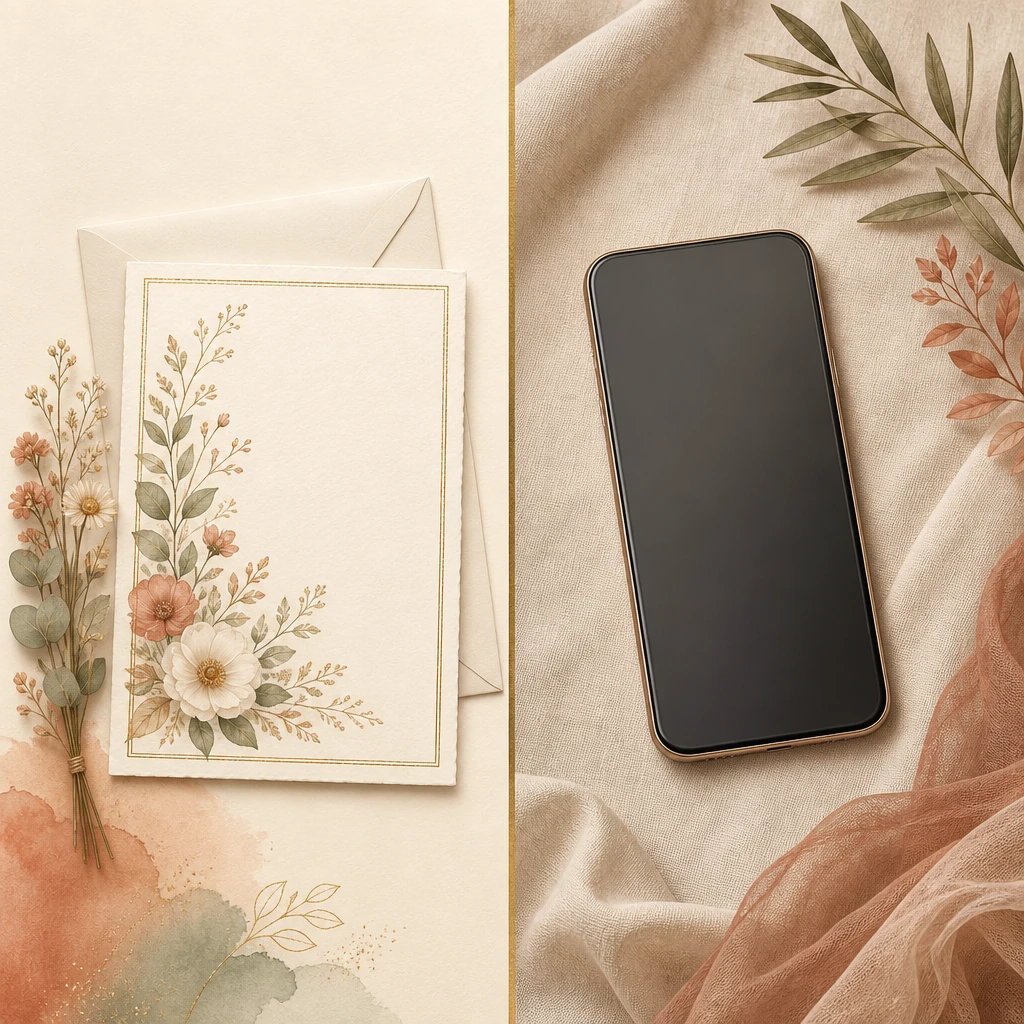
Digital Wedding Invitations vs Printed Cards in Kenya: Which Wins?
The Comparison That Refuses to End
Ask five Kenyan couples how they invited their guests, and you will hear five different answers: all digital, all printed, digital with a printed batch for elders, printed for the traditional ceremony and digital for everything else. The debate between digital invitations and printed cards is one of the most persistent conversations in Kenyan wedding planning — and it will not be settled here, because it should not be. Both formats are excellent at different jobs.
What this guide offers instead is a sharp, honest comparison: how the two formats differ on the things that actually matter to a Kenyan wedding — guest experience, flexibility, keepsakes, etiquette, scale, and feeling. Read it, then decide your own mix with your eyes open.
Round One: The Guest Experience
Printed: The Ceremony of the Envelope
A printed card arrives in an envelope with your name on it. There is a ritual to it — the opening, the unfolding, the weight of the paper. For guests who grew up with cards, that ritual is part of the invitation's meaning. It says: we took the time to make this for you.
The printed card is also finite. It carries what fits on it: names, date, venue, perhaps a line about the reception. Everything else — directions, dress codes, the schedule of the traditional ceremony — travels by word of mouth and WhatsApp.
Digital: The Invitation That Answers Questions
A digital invitation opens into a page that holds everything: the schedule of every event, maps, dress codes, travel notes, the RSVP form, the registry. When a guest wonders "what time is the reception?" the answer is one tap away. For guests who live on their phones — most of the under-forty list — the digital invitation is the natural, effortless experience.
The digital invitation is also interactive: guests can RSVP in thirty seconds, leave a message, and revisit the page when details change. It never goes stale, because you keep it current.
The Verdict on Experience
For information and convenience, digital wins decisively. For ceremony and ritual, printed wins. Most guests will appreciate both — the ritual from the card they treasure, the convenience from the link they use.
Round Two: Flexibility
Printed Is Frozen
Once a card is printed, the date on it is the date. The venue on it is the venue. If the reception moves, if the time shifts, if a second event is added — the card cannot change. Reprinting costs time and money, and nobody wants to explain a corrected card.
Digital Is Alive
A digital invitation can be updated in minutes, and every guest with the link sees the current truth. Venue moved? Update the page, post a short note, and the problem is solved before the first guest asks. This is not a small advantage — in the final weeks of a Kenyan wedding, plans move, and the couple needs an invitation that moves with them.
The Verdict on Flexibility
Digital wins without contest. If your details are not one hundred percent final — and whose are, months ahead? — digital is the format that forgives.
Round Three: Keepsakes and Memory
Printed: The Object in the Drawer
There is no digital equivalent of opening a drawer in your parents' home and finding their wedding card. Paper survives decades. It can be touched, framed, passed down. The printed card is a physical memory of the day, and for families who treasure objects, this is irreplaceable.
Digital: The Living Memory
The digital invitation has its own memory value: it can hold video, music, and your story; it can become a gallery of wedding photos after the day; it can carry messages from guests. It does not sit in a drawer — it is revisited, shared, and (if you keep it live) it grows.
The Verdict on Keepsakes
Each is irreplaceable in its own way. The printed card is a treasure; the digital page is a living archive. This is why so many couples want both: the card for the drawer, the page for the memory.
Round Four: Etiquette and Respect
What Elders Expect
In many Kenyan families, the invitation to elders is a matter of protocol. A card, personally delivered or sent with a family member, carries a weight that a link does not. For elders who value formality, the printed card is respect made visible.
What the Digital Age Added
The etiquette of the digital invitation is different but real: family informed before the general list, warm words around every link, voice notes for elders, personal follow-ups. A digital invitation sent carelessly — bare link, no message, no family-first order — is genuinely disrespectful. A digital invitation sent with care is not.
The Verdict on Etiquette
This round depends entirely on the guest. Know your elders: some will be honoured by a card, others delighted by a voice-note-and-link. The respectful invitation is the one tailored to the person, not the format.
Round Five: Scale and Reach
The Five-Hundred-Guest Math
Here the comparison is stark. A printed invitation for five hundred guests means design, printing, envelopes, inserts, assembly, addressing, and delivery — weeks of logistics and a significant budget line. A digital invitation for five hundred guests is one link, sent in minutes, at no per-guest cost, reaching Nairobi, Mombasa, Kisumu, and the diaspora in the same second.
The Unconnected Guest
But scale cuts both ways: a guest without a smartphone or reliable internet cannot open the link. The printed card needs no battery. At the edges of the guest list — the eldest elders, the rural relatives — paper remains the reliable bridge.
The Verdict on Scale
For reach and cost at scale, digital wins. For the unconnected, printed (or a family member's help) is the only bridge. The best plan uses both: digital for the hundreds, printed for the few.
Round Six: Feeling
Let us be honest about the intangibles.
The printed card says: "We made something physical for you." The digital invitation says: "We made something current for you." Neither is superior; they are different flavours of care. Some weddings are paper weddings — their identity lives in foil and cardstock. Some are link weddings — their identity lives in motion, photography, and interactivity. Most Kenyan weddings are both, because Kenyan weddings contain multitudes: the traditional ceremony and the modern reception, the elders and the diaspora, the formal and the joyful.
The Hybrid: What Most Kenyan Couples Choose
The comparison does not end in a winner — it ends in a blend. The pattern you will recognise from real Kenyan weddings:
- Digital for the general list. The full invitation page with the schedule, maps, RSVP, and registry, sent with warm words through WhatsApp.
- Printed for the honoured few. A small batch of beautiful cards for parents, grandparents, and elders — keepsakes that carry the formal ceremony of the envelope.
- One design language. The same colours, typography, and motifs in both media, so every guest feels they received the same invitation in two forms.
- One source of truth. The digital page carries the current schedule; the card carries the essentials and points to the link.
This blend costs less than full printing, honours more people than full digital, and gives the wedding a design identity that lives in both worlds.
How to Choose Your Own Mix
Work through five questions:
1. Who is on the list, and where are they? Scattered and diaspora-heavy lists need digital; a local, elder-heavy list values print.
2. What is the budget? At scale, digital is dramatically cheaper. Print is a keepsake investment, best made small.
3. What is the timeline? Weeks to spare favour print; short timelines demand digital.
4. What do the families expect? The traditional ceremony's etiquette and the elders' expectations outweigh fashion. Ask early.
5. What do you want to keep? If you want physical keepsakes in the family homes, print a batch — whatever the main send is.
A Worked Example: The Mwangi–Onyango Wedding
To see the comparison in practice, follow one couple's decision. The guest list is 450 people: elders in both families, church members, school and university friends, colleagues, and about sixty relatives in the diaspora. The wedding has three events — a traditional ceremony organised by the families, a church service, and a reception.
The couple's instinct is printed cards, the way their parents did it. Then they run the numbers in the five categories. Printing for 450 with inserts for three events would consume weeks and a significant budget line, and the diaspora relatives would receive cards long after the invitations to local guests. Digital, by contrast, reaches everyone the same second and carries the full three-event schedule.
They choose the hybrid: a small printed batch of beautiful cards for parents, grandparents, and the honoured elders of both families; digital invitations for everyone else. One design language — the same colours and typography — runs through both. When the reception venue changes six weeks out, the digital page updates in minutes, and the cards' "see the link for updates" line saves the day.
The example is not a prescription; it is the comparison method at work. Run your own numbers, and the right mix tends to reveal itself.
The Decision Matrix
| Question | Lean digital when... | Lean printed when... |
|---|---|---|
| Guest list | Large, scattered, partly abroad | Small, local, mostly elders |
| Events | Several, with schedules and maps | One main event |
| Timeline | Short or still moving | Long and settled |
| RSVP load | Hundreds to track | Dozens, easily managed |
| Keepsake wish | A living page and gallery | Physical cards in drawers |
| Budget | Cost per guest matters | The card is the statement |
No single row decides the mix; the pattern across the rows points the way.
Frequently Asked Questions
| Is one format more respectful than the other? | Respect lives in the delivery, not the format. A digital invitation delivered with family-first order and warm personal words is respectful; a printed card sent as an afterthought is not. Know your guests and tailor to each. |
|---|---|
| Can I use digital invitations and still honour the traditional ceremony? | Yes. The traditional ceremony is often organised through family structures; the digital invitation carries its logistics — schedule, venue, dress code — while the families make the announcements in their own way. |
| What should the printed card contain if I also have a digital page? | The essentials: names, date, the main venue, and a line pointing to the link for the full schedule and RSVP. The card is the symbol; the page is the substance. |
| How do I make both formats feel like one invitation? | Share one design system — colours, fonts, motifs — across both. If you use a designer for the card, ask for matching digital styling; if you use a platform, match its themes and typography to the card. |
| Does a digital invitation replace the wedding website? | No — the invitation leads to the website. The digital invitation is the door; the website (with the full schedule, maps, RSVP, and registry) is the room. Print the card, share the link, point everyone to the same destination. |