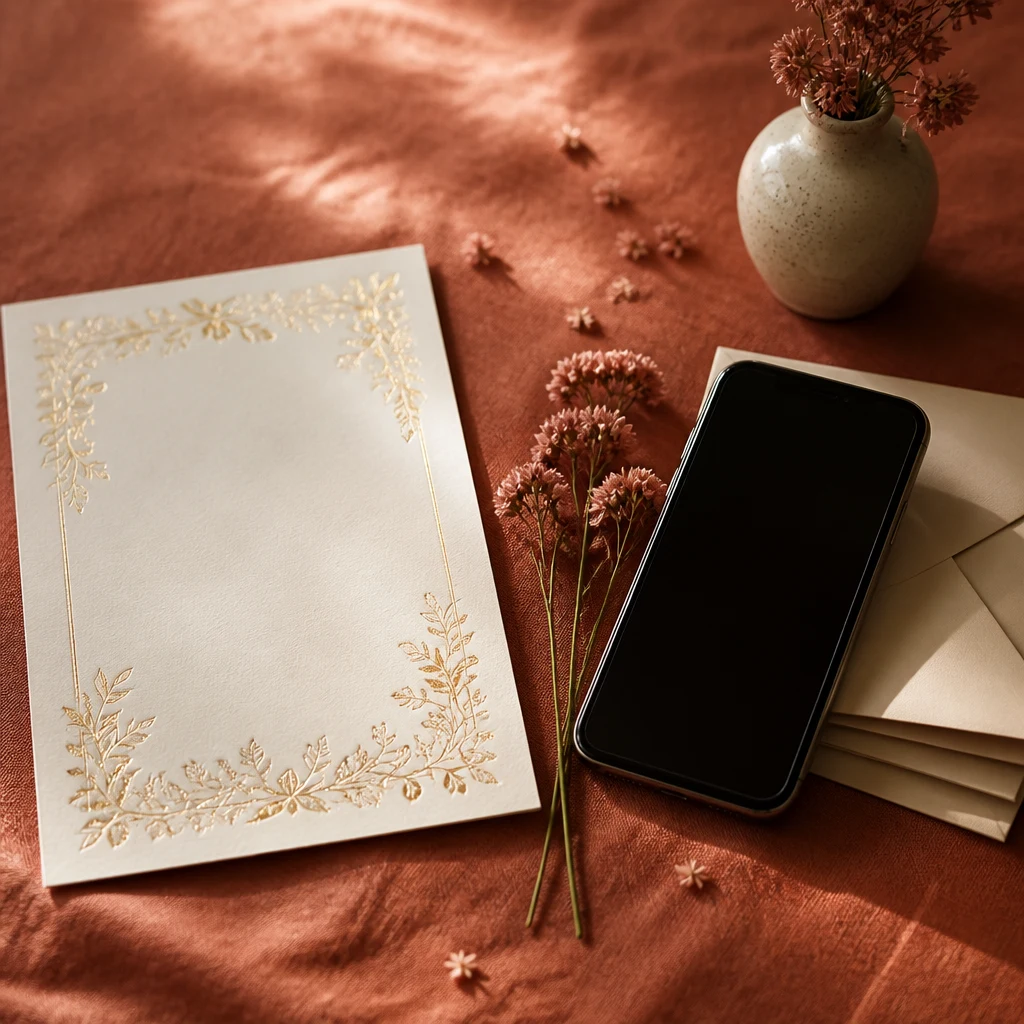
WhatsApp Wedding Invitations vs Printed Cards
Every couple faces the same decision at some point in the planning process: paper or pixels? The printed card is a tradition that goes back centuries, steeped in etiquette and sentiment. The WhatsApp invitation is the new reality — instant, free, and guaranteed to be seen. Which one should you choose?
The honest answer is that it is not a contest with one winner. It is a decision with trade-offs, and the right call depends on your wedding's size, formality, budget, and guest list. This guide lays out the comparison honestly — where each format wins, where each loses, and how a hybrid approach often beats both.
The Case for WhatsApp Invitations
Cost: Near Zero vs. Significant
This is the biggest practical gap. A printed invitation suite for 100 guests — design, printing, envelopes, liners, stamps — commonly runs into the hundreds, sometimes thousands, of dollars depending on the paper and printing method. Add RSVP cards, return postage, and save-the-dates, and the cost compounds.
A WhatsApp invitation costs nothing beyond your data plan. No printing, no postage, no reprints when a typo sneaks through. For couples on a budget — or those who would rather spend that money on the band or the menu — digital wins by a knockout.
Speed: Minutes vs. Weeks
Printed invitations need design time, proofing, printing, envelope addressing, and postal delivery measured in days or weeks. Every revision costs money and time. WhatsApp invitations are delivered in seconds, and a design change costs nothing — update the image, resend, done.
This speed matters at every stage: save-the-dates, the main invitation, schedule changes, and final reminders all travel instantly.
Reach and Open Rates
A printed card can sit unopened in a mailbox or under a pile of bills for weeks. A WhatsApp message lands in the app guests check constantly. Delivery is near-instant, and read receipts tell you who has actually seen it. For actually getting information in front of people, WhatsApp has a structural advantage.
RSVP Management
This is where digital stops being "good enough" and becomes flatly superior. Paper RSVP cards require guests to find an envelope, write a note, and mail it back — then you transcribe every response into a spreadsheet. A WhatsApp-delivered RSVP form captures attendance, plus-ones, and dietary preferences automatically, and a dashboard shows your live headcount as responses arrive.
Eco-Friendly
Digital invitations produce zero paper waste and zero postal emissions. For environmentally conscious couples, this is a genuine value, not a marketing talking point.
Easy Updates
Venue changed? Ceremony moved an hour earlier? With print, you either eat the cost of reprinting or send follow-up cards. With digital, you update the website or send one broadcast message, and every guest is current.
The Case for Printed Cards
The Keepsake Factor
Here is the argument no digital invitation can fully answer: a physical card is a tangible memory. Guests pin them to fridges, tuck them into memory boxes, and decades later, they resurface at family gatherings. Your grandparents' invitation from 1962 is probably still in a drawer somewhere. A WhatsApp message cannot be framed, and a chat thread is not a keepsake.
Formality and Tradition
For formal weddings — black tie, cathedral ceremonies, society guest lists — printed cards carry an etiquette weight that digital cannot replicate. Etiquette guides still describe multi-piece invitation suites with specific wording conventions, and some families genuinely expect that. Fighting tradition on a 300-guest formal wedding is a battle with no upside.
The Ceremony of the Send
There is a ritual to handwriting envelopes and watching cards disappear into the post. Some couples — and some parents — value that ritual itself. It signals care in a way that a broadcast list cannot.
Older Guests
Many older guests are comfortable with WhatsApp but still treasure receiving a physical card, and a printed card is also the ultimate fallback for anyone who does not use smartphones well. If a meaningful chunk of your guest list is over 75, print guarantees nobody is left out of the invitation moment.
Higher Perceived Effort
Let's be blunt: a beautifully printed invitation signals that you invested in your guests. Because it costs money and effort, recipients perceive more importance. Digital invitations can read as "you weren't worth the stamp" if not done with enough polish — though a well-designed digital invitation largely neutralizes this perception.
A Realistic Cost Breakdown
A concrete example makes the gap easier to feel than abstract percentages. Take a wedding with 120 guests, roughly 80 households:
- Printed route: a design or premium template at $50–$300; printing 80 invitation suites at $4–$12 each ($320–$960); envelopes and liners at $80–$200; postage at $1–$5 per card, more for any international guests; plus RSVP cards with return postage. Realistic total: $600–$1,800, two to three weeks of production and mailing time, and no way to verify delivery — cards get lost in the mail, and you will never know which ones.
- WhatsApp route: free messages; a designed image invitation (free templates, or $20–$100 for a custom design); and a website with RSVP forms (free to modest platform fees). Realistic total: $0–$150, delivered in an afternoon, with read receipts confirming delivery and a dashboard counting responses.
The gap is not small — for many couples it is the difference between upgrading the band or the menu and not. None of this proves print is wrong; it proves the choice deserves deliberate budgeting rather than default tradition. If the keepsake value and formality are worth the money to you, spend it happily. If they are not, the savings are yours to redirect somewhere your guests will actually feel it — the food, the music, the experience of the day itself.
The Comparison, Side by Side
| Factor | WhatsApp Invitation | Printed Card |
|---|---|---|
| Cost | Free to near-free | Significant (design, print, postage) |
| Speed | Instant delivery | Days to weeks |
| Reach | Everyone with WhatsApp; delivery confirmed | Universal, but delivery unverifiable |
| RSVP handling | Automatic forms, live headcounts | Manual cards, manual transcription |
| Keepsake value | None | High |
| Formality | Perceived as casual (can be elevated with design) | Traditional gold standard |
| Updates | Instant, free | Costly or impossible |
| Eco impact | Minimal | Paper, ink, transport |
| Personal touch | High, with individual messages and unique links | High, with handwritten envelopes |
| Data tracking | Open rates, response tracking | None |
When WhatsApp Wins (Choose Digital If...)
- Your wedding is casual, modern, or destination-oriented
- Your guest list is large and spread across countries — international postage is brutal
- You are on a tight budget or prefer to spend on the event itself
- You want effortless RSVP tracking with live headcounts and dietary preferences
- Your guests skew younger and tech-comfortable
- Your date is close and you need speed
When Print Wins (Choose Paper If...)
- The wedding is formal and tradition matters to your families
- You have a small guest list of people who would treasure a keepsake
- A significant number of guests are older or non-digital
- You or your family place real value on the ritual of sending cards
- Budget is genuinely not a concern
The Hybrid Approach: The Best of Both
Here is the open secret of modern wedding invitation strategy: you do not have to choose. The hybrid model uses each format for what it does best.
The Classic Hybrid
- Save-the-date: printed card (optional) or WhatsApp (recommended for speed)
- Main invitation: printed card for the keepsake and formality, with a QR code or short URL on it linking to your website
- Everything else: digital — the website holds the schedule, map, registry, and RSVP form
- RSVPs: digital form (with a phone number fallback for those who need it)
- Follow-ups and reminders: WhatsApp broadcasts, targeted to whoever has not responded
This approach gives guests the emotional card to keep, the practical website to use, and the modern RSVP system that saves you weeks of admin. It is more expensive than all-digital but far cheaper than full traditional printing, because you can use simpler, lighter printed pieces (a single card instead of a multi-piece suite) while the website carries the detail load.
The Digital-First Hybrid
- Main invitation: designed WhatsApp image invitation plus website link
- Printed piece: one beautiful card per household (or for older guests only) — keepsake coverage without printing 300 suites
- RSVPs and reminders: fully digital
The Printed-First Hybrid
- Printed suite: for formal segments of the guest list (family, VIPs)
- WhatsApp: for friends, coworkers, and international guests
- Website and RSVP forms: for everyone
Making the Decision: A Simple Framework
Ask yourself four questions:
1. How formal is the wedding? Formal leans print; casual leans digital.
2. Who are the guests? Older or traditional-leaning lists deserve paper; younger lists are happiest digital.
3. What is the budget? Tight budgets should go digital-first and spend saved money on the event.
4. How much do you value tracking? If you want live headcounts and easy follow-ups, digital infrastructure is non-negotiable — even with printed cards, route RSVPs digitally.
If the answers point in opposite directions, that is your sign to run a hybrid — the format that is usually right for everyone.
Frequently Asked Questions
Is it rude to send a wedding invitation by WhatsApp? No, and it is increasingly normal. What reads as rude is a sloppy, impersonal message. A well-designed WhatsApp invitation with a personal note and a proper RSVP flow is received warmly by most guests.
Are printed invitations worth the cost? If the keepsake and tradition matter to you and your families, yes. If you would rather allocate that budget elsewhere, guests will not mind digital — especially when it is done beautifully.
Can I have printed invitations AND digital RSVPs? Yes — this is the most common hybrid. Print the card with a QR code or URL; guests RSVP through the form. You get the keepsake and the clean data.
How do I handle older guests in a digital-first approach? Print for them, call them, or send a WhatsApp message followed by a phone call. Nobody should miss the invitation because of the channel.
Which format has better RSVP response rates? Digital, and it is not close — forms are one tap away and reminders are instant. Paper RSVPs routinely go missing or get forgotten.
Final Thoughts
WhatsApp invitations and printed cards are not enemies; they are different tools with different strengths. Print owns emotion, tradition, and keepsakes. WhatsApp owns cost, speed, reach, and — decisively — RSVP management. For most couples in most situations, the smartest answer is not one or the other but a blend: the beauty of paper where it matters, the efficiency of digital everywhere else, and a website that gives every guest one place for all the details.
Choose deliberately, based on your wedding's formality, your guest list, and your priorities — not on habit. Both formats, used well, will do the one thing that matters: getting the people you love to your wedding.